AI provides intelligence. Your operating model provides control. Meridian is the operation kernel for the AI era — ten cognitive executives reasoning continuously across every signal in your business, on one governed substrate you command.
AI 1.0 was single-turn cognition through a chat window — state ephemeral, the model the product, quality measured by benchmark. AI 2.0 is the infrastructure era: AI embedded in how organizations actually run — persistent, multi-tenant, auditable, governed. AI 2.0 is not what AI 1.0 becomes when the models improve. It is a different category of system. And every category of system eventually needs an operating system.
A model behind a prompt box. State resets every session. Impressive in the demo, brittle in production. The model is the product, and the human is still the integration layer between it and the business.
Intelligence that persists, remembers, and acts — under audit, under policy, across tenants. The system runs the business continuously. The human governs it. This is the era Meridian is built for.
Every AI system has two kernels. The cognition kernel — the language model — judges, generates, and infers. The frontier labs build it, and they are extraordinarily good at it. The operation kernel is everything around it that turns cognition into deployable system behavior: routing, validation, persistence, audit, multi-tenancy, trust enforcement, migration.
One kernel cannot do both jobs. Trust does not live in language. Cognition does not scale through inter-agent negotiation. A process cannot be its own audit trail. The operation kernel has never been built deliberately by anyone — the industry ad-hocked around its absence with tool-call frameworks and orchestration libraries that were never designed as infrastructure.
The model is becoming infrastructure. Meridian is the infrastructure.
Judgment, generation, inference. Improves every quarter. A commodity input Meridian consumes — and can swap as the frontier moves.
Routing, validation, persistence, audit, multi-tenancy, trust. Deterministic by design. The defensible layer — and the one nobody else is building deliberately.
"The winners won't have the smartest model. They'll have the best control plane."
The AI Operating Model — the thesis Meridian is built to answer
Stripe for revenue. QuickBooks for cash flow. GitHub for engineering. Gmail for customer signals. None of them talk to each other. You are the integration layer — manually stitching together what your business is actually doing. The AI you've added only widened the gap: a smarter window onto a business that still can't see itself.
What if your entire business lived in one place — and it could think?
The Business AI Operating System. One cognitive substrate that treats your entire business as a single interconnected organism — a living knowledge graph connecting every signal, AI executives that reason continuously, and an interface that grows with your company.
Built on one principle: build everything, acquire nothing — one unified product, the way Epic built healthcare. A single substrate replaces a six- to seven-figure stack of disconnected tools, with one ledger and one audit trail underneath all of it.
Not a chatbot. Not a copilot. A nervous system.
Meridian's AI C-Suite is a team of cognitive executives. Each reasons through the lens of history's most influential minds — and they think continuously, independently, across every signal in your business, converging only by design.
"Intelligence isn't artificial. It's inherited."
Meet Elias. He runs a $1.8M ARR B2B SaaS with 140 customers, 2 contractors, and his Meridian AI C-Suite. Follow his Tuesday.
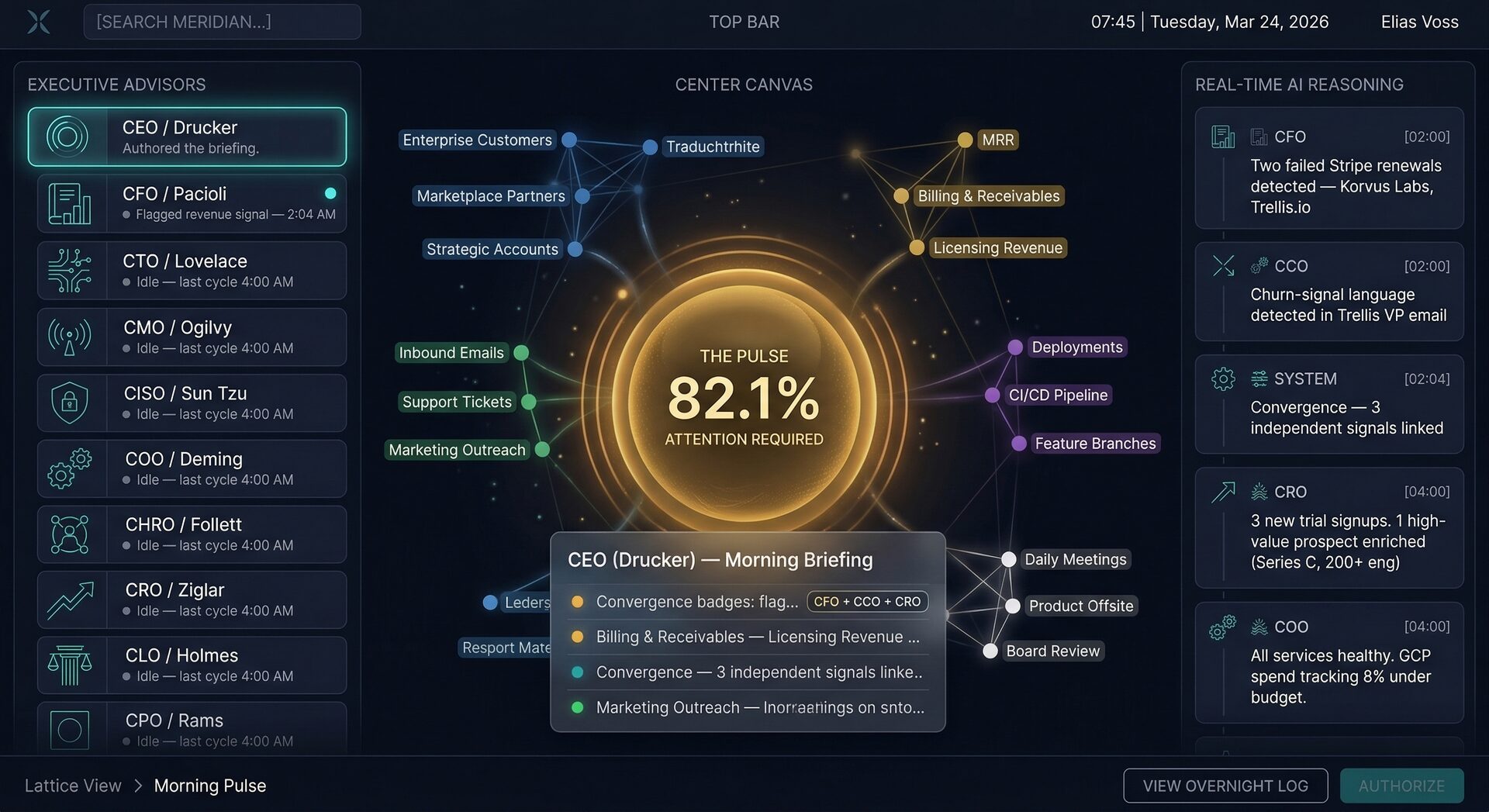
Elias opens Meridian. The Pulse glows amber — not green. While he slept, three AI executives independently analyzed overnight signals and converged on one conclusion: a customer is about to churn.
A failed Stripe renewal. A suspicious support email. A drop in product usage. Three weak signals from three separate systems, stitched together by three separate minds into a single, actionable insight.
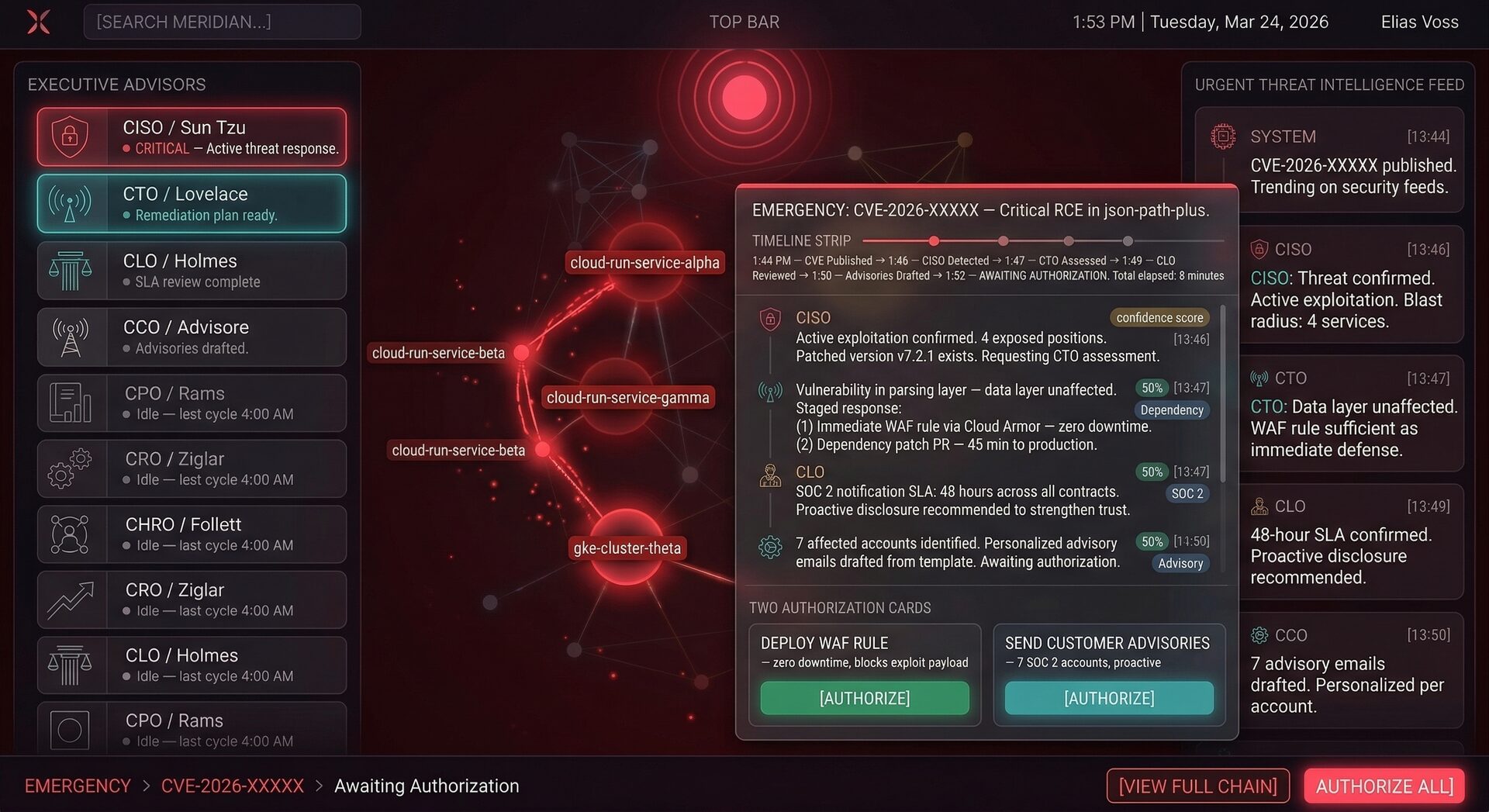
A critical security vulnerability is published in a dependency. The Pulse turns red.
The AI CISO detects it from a continuous threat feed within minutes. The CTO builds a remediation plan. The CLO checks customer notification SLAs. The CMO drafts disclosure emails. Elias reviews the chain. One click: Authorize.
Interface screenshots are AI-generated conceptual renderings representing Meridian's design vision. Final product may vary.
And every AI executive is smarter tonight than they were this morning — because they remember everything that happened.
Tesla didn't invent the electric car. It rode a convergence — batteries, motors, computers, cameras, and screens all arriving at once. The convergence Meridian rides is cloud computing and AI maturing at the same moment.
The cognition kernel is finally good enough to trust with judgment. The cloud is finally cheap and programmable enough to run a deterministic operation kernel around it. Neither was true three years ago. Both are true now — and the operation kernel is still unbuilt. That is the window.
Meridian lands narrow and expands into the substrate every business runs on. The wedge is speed. The destination is a system that builds itself.
The first customer is the AI-native, tiny-team startup automating every internal function. The day-one wedge is speed: routing, validation, persistence, audit, and multi-tenancy out of the box — instead of the year a team would spend building that foundation, or the debt it takes on by skipping it. It lands first with founders who already know they need it: burned before, regulated-adjacent, or selling into enterprises that demand audit and trust on day one.
Because everything is composable bricks and the rules are deterministic, the customer stops building software. They state what they want, and the product is composed in front of them — the interface itself reconfiguring as the configuration changes. The end state: a new business is spoken into existence and iterated in real time, rather than constructed. Meridian becomes the one platform a new business runs on.
Meridian does not ask you to trust a track record it does not yet have. Trust is built into the architecture. It is deterministic — behavior is verifiable, not taken on faith. It is auditable — every action is a tamper-evident record you can watch live. And it is third-party attestable — SOC 2 and the rest, earned over time.
The result is the answer to the first question every serious buyer and regulator asks: can we trust the system? Compliance becomes a query, not a fire drill. You verify rather than hope.
Two decades in enterprise security. CISSP certified. Architected and deployed security across thousands of customer environments worldwide — every vertical, every scale, every failure mode. Four products shipped solo in twelve months, each surfacing the same missing layer underneath. Meridian is that layer, built deliberately.
The 20X company. Why the autonomous enterprise is inevitable — and what it takes to get there.
One cognitive substrate. Intelligent routing. Fractal decomposition. A living memory that compounds.
Cognitive isolation. Independent reasoning. The anti-collusion architecture that makes AI trustworthy.
Eight categories. One substrate. What you'd pay for the stack versus what you'd pay for Meridian.
Deterministic. Auditable. Attestable. Zero-trust agents and audit by default, from day one.
Four products shipped in twelve months. The roadmap ahead. Investor inquiries welcome.
Investor inquiries, partnerships, and early-access walkthroughs. The operation kernel is the unbuilt half of AI 2.0 — and the window is open now.